
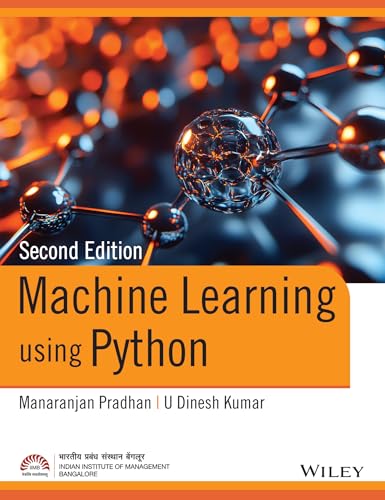
Machine Learning using Python_2nd Edition
Publication details: Wiley New Delhi 2025Edition: 2Description: 468 Item Weight : 767 g Dimensions : 24.1 x 17.1 x 1.9 cmISBN:- 978-9370609167
- 006.31 MAN
| Item type | Current library | Collection | Call number | Status | Date due | Barcode | |
|---|---|---|---|---|---|---|---|
| Text Book | VAST Central Library | Computer Science and Engineering | 006.31 MAN (Browse shelf(Opens below)) | Checked out to Honey Mol P K (EMP420) | 18/03/2026 | 38175 |
Machine Learning using Python offers a comprehensive foundation in machine learning, blending theoretical concepts with practical applications. It is ideal for beginners and aspiring professionals, covering all essential topics to build a strong foundation in machine learning. The book begins with python language basics, statistics, probability, and exploratory data analysis, and then progresses to supervised learning techniques like linear and logistic regressions, decision trees, KNN, SVM, random forests, boosting, stacking, recommender systems, and text analytics. It also explores unsupervised learning techniques such as clustering, anomaly detection, and dimensionality reduction. The book also addresses advanced topics like ML explainability and MLOps, including model interpretation, deployment, and monitoring. Each chapter includes real-world use cases and step-by-step Python implementations using libraries like Pandas, NumPy, Matplotlib, Seaborn, and Sci kit-learn.
There are no comments on this title.